Snake, Auger or Hose? How a Capão Redondo Technician Picks the Right Tool
You are standing in a Capão Redondo kitchen at 7 p.m., watching water rise in the sink while a technician unloads what looks like a metal rope and a pressure hose. He picks one, not the other, and you wonder: how does he know? For anyone searching for a desentupidora Capão Redondo São Paulo SP, that choice is the whole job. The right tool depends on where the blockage sits, what it is made of, and how the pipe is built.
This is not a product catalog. It is a decision tree—the same branch points a trained crew runs through before touching a drain. Read it once and you will understand why a technician sometimes reaches for a hand auger and other times calls in a truck-mounted jetter.
Step One: Read the Symptom Before Choosing the Tool
The first branch is not the tool; it is the symptom. A single slow drain in a bathroom sink tells a different story than a gurgling floor drain or sewage backing up into a shower. Technicians in Capão Redondo treat each signal as a clue about location and severity.
Localized slow drain vs. multiple fixtures backing up
If only one fixture drains slowly, the blockage is likely nearby—a hair clot in the P-trap, grease in the kitchen line, or soap scum in the bathroom branch. If two or more fixtures on the same floor gurgle or back up together, the obstruction has moved into the main branch or the building stack. That distinction decides whether a handheld snake is enough or whether the crew needs equipment that reaches the main line.
Gurgling, odors and rising water
Gurgling means air is being pulled through a trap because water cannot pass freely. Persistent odors suggest decomposing material coating the pipe walls, not just a plug. Rising water in a low fixture—like a floor drain—often points to a downstream blockage in the building sewer. Each of these symptoms nudges the technician toward a different branch of the decision tree.
Branch Two: Match the Tool to the Pipe and the Blockage
Once the symptom narrows the location, the next branch is material and pipe type. A 40-year-old cast-iron stack in a Capão Redondo building behaves differently from PVC in a newer renovation. The tool must clear the blockage without cracking the pipe.
Hand snake or drain auger: short, direct blockages
A hand snake—also called a drum auger—is the first reach for sinks, showers and toilet traps. It is a flexible cable that rotates through a short run of pipe and hooks or breaks up hair, paper and soft clogs. It is cheap, fast and low-risk on small-diameter lines. The limit is distance: a hand snake struggles past a few meters, and it cannot cut through grease or roots.
Powered auger or rooter: longer runs and tougher clogs
When the blockage sits deeper—past the trap and into a branch line—a powered auger or rooter takes over. These machines drive a heavier cable with a cutting head that can break up compacted waste or light root intrusion. They are the standard choice for toilet lines and short main-line runs in residential buildings. The trade-off is aggression: a powered auger used carelessly on old pipes can scar the interior or damage joints.
Hydro-jetting hose: grease, scale and full-pipe cleaning
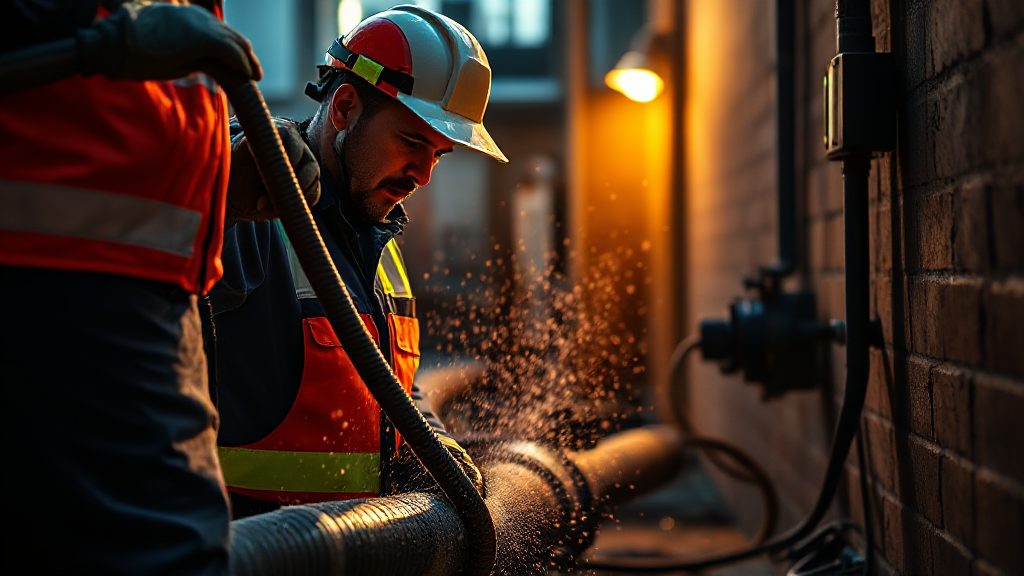
Hydro-jetting uses high-pressure water through a specialized hose and nozzle to scour the entire pipe wall. It is the branch for grease-heavy kitchen lines, scale buildup in older pipes, and any blockage where the goal is not just to punch a hole but to restore full diameter. For a desentupidora Capão Redondo, jetting is often the difference between a temporary fix and a line that stays clear. It requires access points and enough pressure, so it is not the first tool for a simple sink clog.
When camera inspection comes before any tool
If the symptom is repeated backups in the same spot, or if sewage backs up into multiple fixtures, the technician may run a camera first. A camera shows whether the problem is a collapsed pipe, a root mass, or a belly in the line where waste collects. Choosing a tool before seeing the pipe is how small problems become excavation projects.
Branch Three: Access, Safety and the Building Around the Pipe
The third branch is not about the clog at all—it is about the space around it. A Capão Redondo technician working in a ground-floor apartment has different access than one in a basement with a cleanout or a backyard with a sewer inspection chamber. Access determines which tools are practical.
Cleanouts, traps and inspection chambers
A cleanout gives direct entry to the main line, which makes powered augers and jetting hoses far more effective. Without one, the technician may have to work through a fixture, remove a toilet, or open a trap. That extra step changes the tool choice: a job that would be a 20-minute jetting run becomes a longer snake-and-access operation.
Water pressure, electrical safety and confined spaces
Hydro-jetting needs a reliable water source and a safe electrical setup for the pump. Confined spaces like basements and utility rooms require ventilation and careful handling. A technician who ignores these constraints can damage equipment or create a hazard. The best crews treat safety as part of the decision tree, not an afterthought.
Branch Four: What the Decision Tree Looks Like in Practice
Here is how the branches combine into a real sequence. A technician arriving at a Capão Redondo home with a backed-up kitchen sink will first ask whether other fixtures are affected. If only the sink is slow, a hand snake through the trap is the first attempt. If the snake meets resistance deep in the branch, a powered auger follows. If grease is the likely culprit, jetting is scheduled.
The same logic applies to a building with multiple complaints. A desentupidora em Capão Redondo São Paulo SP will often start with a camera inspection to map the line, then choose jetting for grease or roots, or a rooter for a hard obstruction. The goal is to match the tool to the evidence, not to the loudest symptom.
| Symptom | Likely location | First tool | Why |
|---|---|---|---|
| One slow sink or shower | Trap or short branch | Hand snake | Short, soft clog; low risk |
| Toilet backs up, others fine | Toilet branch | Powered auger | Longer run, compacted waste |
| Kitchen line slow, grease smell | Kitchen branch | Hydro-jetting | Grease coats the whole pipe |
| Multiple fixtures gurgle | Main branch or stack | Camera, then jetting or rooter | Need to see the line first |
| Repeated backups in same spot | Main line defect | Camera inspection | Rule out collapse or roots |
Notice that the table is not a menu. It is a set of starting points. A technician may switch tools mid-job if the first attempt reveals something the symptom did not.
Common Mistakes When Choosing a Tool in Capão Redondo
The most common mistake is reaching for the most powerful tool first. A jetter on a fragile old pipe can cause more damage than the clog itself. The second is ignoring the pattern of symptoms—treating a building-wide backup as a single sink clog. The third is skipping the camera when the same line backs up repeatedly.
A good crew explains the branch it is taking and why. If a technician cannot tell you whether the blockage is local or in the main line, ask. That question is the heart of the decision tree, and it is the difference between a quick fix and a repeat visit.
In the end, the choice between snake, auger and hose is not about brand or price. It is about reading the symptom, matching the tool to the pipe, respecting access and safety, and being willing to switch branches when the evidence changes. That is how a Capão Redondo technician turns a messy backup into a clear, predictable repair.